
Erasmus+ Is Once Again Available at Every Hungarian University
We celebrated this Milestone with Young People in Budapest
Erasmus+ international mobility opportunities are once again available at every Hungarian university.
To mark this milestone, Roxana Minzatu, Executive Vice-President of the European Commission, and Judit Lannert, Minister of Education and Children, celebrated alongside former and future Erasmus students in Budapest.
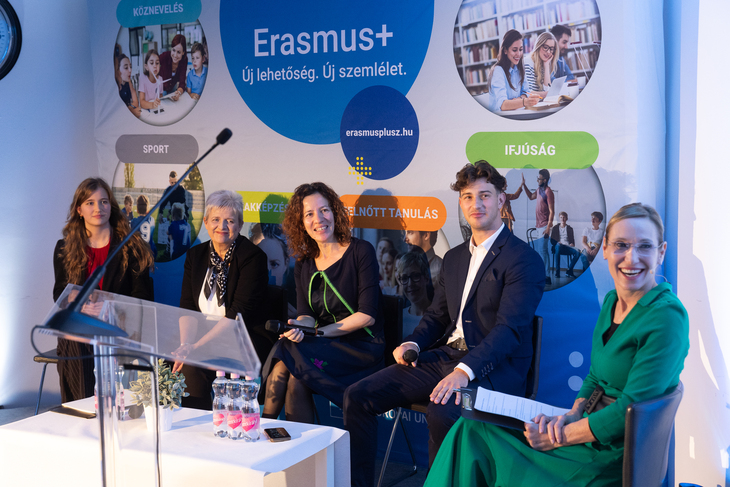 The lively panel discussion was moderated by Kriszta Bombera.
The event focused on the value of international experiences, learning together, and the future of European unity.
The fully return of Erasmus+ to Hungarian universities opens a new chapter in the history of international relations in Hungarian higher education. Thanks to the European Council decision lifting the restrictions introduced in 2022, the programme’s international mobility opportunities are once again available at all Hungarian universities. This represents an important step forward not only for university communities but also for young people, opening up new opportunities to learn, gain experience, and build international connections.
This significant milestone was celebrated in Budapest at an event organised by the Tempus Public Foundation, Erasmus Student Network Hungary, and the European Commission Representation in Hungary. Roxana Minzatu, Executive Vice-President of the European Commission responsible for Social Rights and Skills, Quality Jobs and Preparedness, and Judit Lannert, Minister of Education and Children, shared their thoughts with participants. Former and future Erasmus students also took part in the discussion, enriching the exchange with their own questions and perspectives. The panel discussion was moderated by Krisztina Bombera.
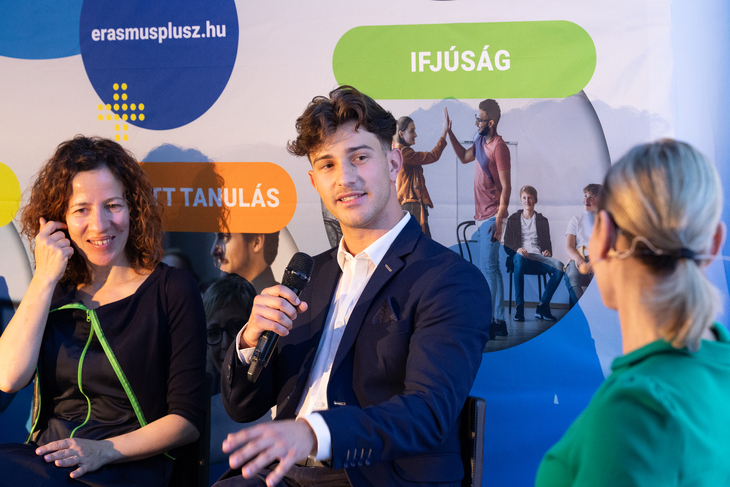 Young people also had the opportunity to share their experiences.
„Erasmus+ Is Whole Again with Hungarian Students”
In her speech, Roxana Minzatu emphasised that the significance of Erasmus+ extends far beyond individual academic and professional experiences. She described the programme as one of the key instruments for building Europe, contributing to a stronger shared identity, a sense of belonging, and democracy.
“Erasmus+ is whole again with Hungarian students,” the Executive Vice-President said, underlining how pleased she was that students from every Hungarian university could once again participate in the programme.
Roxana Minzatu also highlighted how international mobility can deepen self-awareness. When people step outside their familiar surroundings, they encounter new cultures, perspectives, and ways of thinking, while also discovering their own identities from a different point of view.
This is precisely where the strength of Erasmus+ lies: beyond offering personal experiences, it creates encounters and opportunities that shape participants’ thinking, openness, and relationships with their communities over the long term.
Speaking about the programme’s future, the Executive Vice-President also stressed the importance of further development and accessibility. Plans for the European Union’s next budgetary period, covering 2028–2034, include proposals to increase Erasmus+ funding. As she pointed out, the aim is to make the programme accessible to even more people and to extend opportunities for learning and exchanging experiences to a wider audience.
“Erasmus+ builds Europe, strengthens European citizenship, a sense of belonging, and democracy.” This was one of the central messages of her remarks: the programme not only supports participants’ personal development but also plays a role in shaping our shared European future.
She added that the growing influence of artificial intelligence and the transformation of education could make Erasmus+ even more important. Exploring different educational environments, learning together, and sharing knowledge are valuable experiences that can provide a sense of direction and stability in a rapidly changing world.
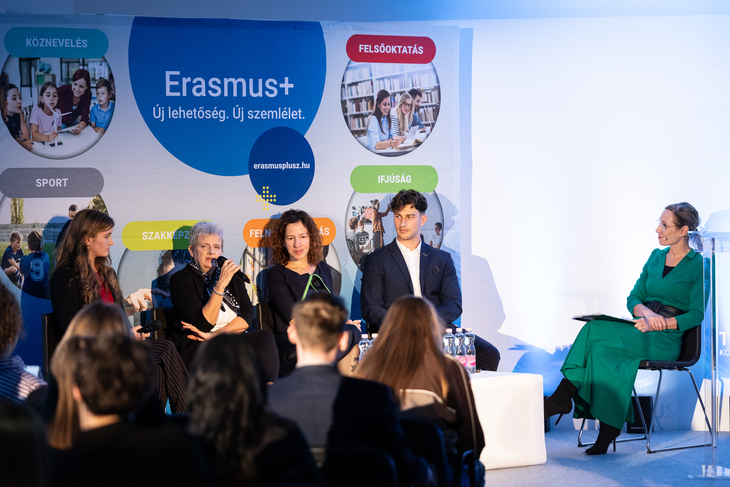 Judit Lannert (with the microphone), Minister of Education and Children, spoke about the importance of gaining international experience.
The Future of Education Needs Curious, Creative Young People Who Think Independently
Judit Lannert, Minister for Education and Children’s Affairs, spoke about the renewal of education and the opportunities available to young people. She emphasised that the purpose of education today can no longer be limited to transmitting knowledge. In a constantly changing world, we need young people who can think independently, ask questions, challenge conventional answers, and find creative solutions to new challenges.
Erasmus+ contributes to this development, too. During a study period abroad, students not only acquire new knowledge but also discover different teaching methods, cultures, and ways of thinking. The experiences they gain in unfamiliar situations help develop adaptability, independence, openness, and critical thinking.
The Minister’s remarks drew attention to the importance of an educational approach in which young people are not merely recipients of knowledge but active participants in shaping their own learning. International experiences give students the opportunity to formulate new questions, step beyond familiar boundaries, and find their own paths.
Preparing for the future begins with curiosity: with the courage to ask questions, think differently, explore new paths, and learn from one another. Erasmus+ creates an environment in which these experiences can become an integral part of young people’s personal development.
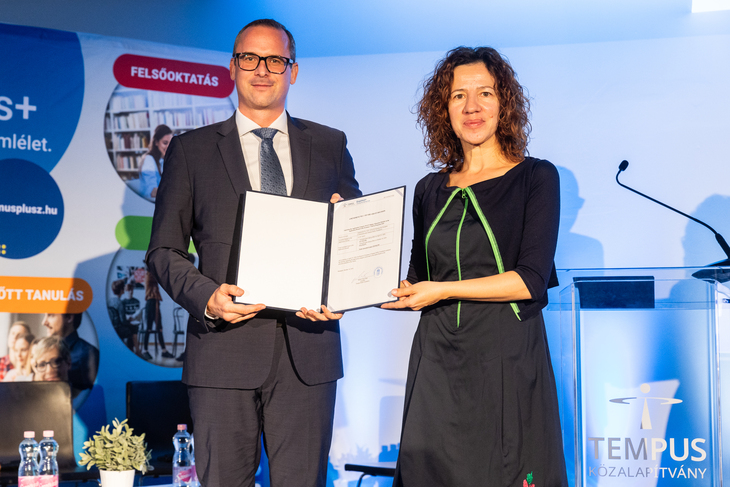 Dr. Balázs Vince Nagy, President of the Tempus Public Foundation, hands over the decision document regarding Erasmus+ funding for the 21 model-changed universities to Roxana Mînzatu, Vice-President of the European Commission.
“The main hope of a nation lies in the proper education of its youth.”
Dr Balázs Vince Nagy, President of the Tempus Public Foundation, began his welcome address with a quotation attributed to Erasmus of Rotterdam: “The main hope of a nation lies in the proper education of its youth.” He highlighted that the Tempus Public Foundation has been actively managing international mobility programmes for 30 years. Three decades represent not only longevity but also a wealth of experience.
“At the Tempus Public Foundation, we continuously work to align regional and domestic mobility opportunities so that young people can benefit from as many of these opportunities as possible,” he explained.
This milestone is not merely symbolic; it also has tangible significance. To mark this milestone, Dr Balázs Vince Nagy formally presented Executive Vice-President Minzatu with the decision document concerning the newly signed Erasmus+ grant agreements for the 21 universities that can now join again the Erasmus+ programme.
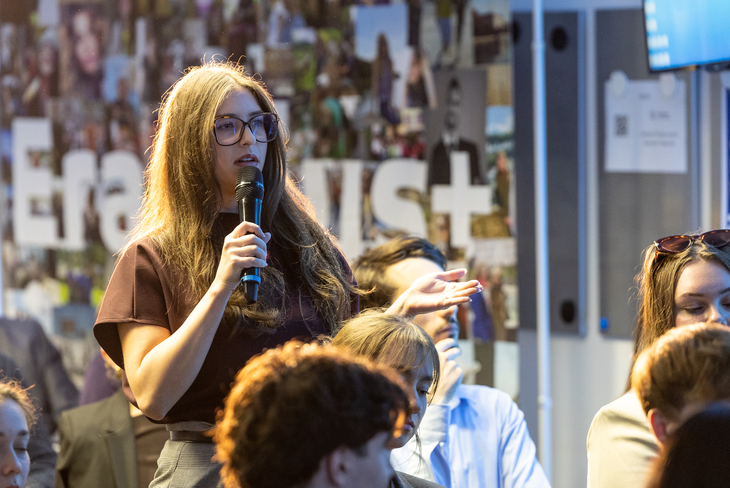 Q&A
Shared Experiences, a Shared Future
What made the event particularly special was that, alongside policy discussions and an exchange of views on the programme’s future, students also played an active role. The panel discussion featured Kinga Gabányi, a student at Eötvös Loránd University who previously participated in Erasmus+ in Italy, and Dénes Bana, a student at the University of Pécs who is planning a future Erasmus mobility period now that his university has rejoined the programme.
Audience members had the opportunity to ask questions, while the young participants could share their thoughts and engage directly in the conversation about the future of Erasmus+.
The presence of former and prospective Erasmus students illustrated how the programme represents both a personal opportunity and a shared community value. The connections formed, skills acquired, and new perspectives gained through international mobility continue to have an impact long after students return home. They can influence university communities, professional careers, and future collaborations.
Erasmus+ is once again available at every Hungarian university, and the next chapter will be written by the young people who seize this opportunity. They will set off on new journeys, gain fresh experiences, build connections, and bring their knowledge and memories back to their own communities.
The Erasmus+ Reloaded gathering in Budapest was therefore more than a celebration of an important milestone: it was also an expression of confidence in the future. It reaffirmed that, through learning, openness, and learning from one another, young people can not only expand their own horizons but also help shape a more cooperative, diverse, and united Europe.
Photo: Tamás Lékó